
Do You Need a Personal Website to Land a Job in Sports & Entertainment?
Sep 25, 2026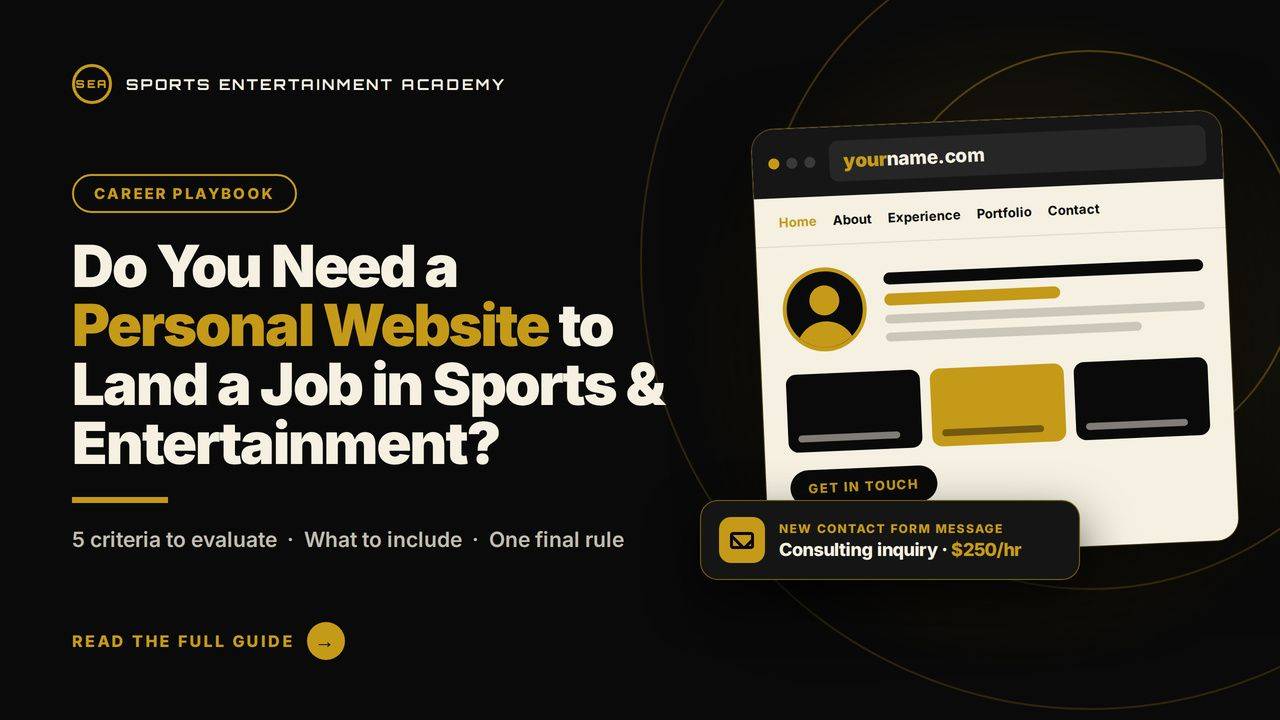
The short answer is no.
However, if you work in a creative, marketing, partnership, media, content, production or other portfolio-driven roles, a personal website can be a powerful way to bring your experience to life and give people another way to discover your work.
And unlike LinkedIn, your personal website is an online asset that you control.
So, should you build one?
There are dozens of platforms you can use to create a personal website. Rather than choosing one based solely on price or how attractive the templates look, we recommend evaluating each platform using these five basic criteria:
1. Ease of Use
How quickly can you build your site and do you need coding or technical experience?
If you're not comfortable with technology, a drag-and-drop platform may be worth paying more for if it saves you hours of frustration.
2. Design & Templates
Do the available templates fit your personal brand and the type of work you want to showcase?
A photographer, graphic designer, sports marketer and sponsorship executive may all need very different types of websites.
3. Maintenance
How much ongoing work is required to keep the site secure, current and functioning properly?
Some platforms are relatively hands-off, while others may require regular updates, plugins or technical maintenance.
4. SEO & Discoverability
How easily can search engines crawl, index and understand your site?
SEO isn't simply about choosing the platform with the "best SEO." Your content, site structure, technical setup, relevance and many other factors can influence how your website appears in search results.
5. Total Cost
What will you actually spend each year?
Don't just look at the advertised monthly subscription. Consider the total cost, including your domain name, hosting/platform subscription, plugins, apps and any other tools you need.
One of the biggest benefits: owning another piece of digital real estate
You don't need a personal website to work in Sports & Entertainment.
But there is one particularly valuable reason to consider building one:
Greater control over your online presence.
When someone searches your name on Google, the results they see become part of your professional reputation and if another person with your same name pops up instead and represents you in a non-desired way, that alone can justify the investment in your own personal website.
Owning a domain that includes your name - such as yourname.com or the closest available variation - gives you a professional destination that you control.
You can connect it to your LinkedIn profile, portfolio, social channels, media appearances, projects and other professional content.
It doesn't guarantee that your website will appear first in Google, but it gives you another owned asset that can help establish your professional identity online.
And importantly, you don't have to choose between LinkedIn and a personal website.
They can work together.
Think of LinkedIn as your professional network and your website as your professional home base.
What should you put on your website?
You don't need a 20-page website.
For most professionals, a simple structure is enough to start:
Home
Who you are, what you do and what you want to be known for.
About
Your background, expertise and career story.
Experience
Relevant roles, accomplishments and career highlights.
Portfolio
Your best work, projects, campaigns, presentations, case studies, testimonials, media or other proof of what you can do.
Contact
Give people an easy way to reach you.
Depending on your background, you could also add sections for:
Volunteer Experience | Speaking | Talent Managed
With today's AI-powered website builders and design tools, creating a professional site is significantly easier than it used to be.
And a personal website can sometimes create opportunities you weren't looking for.
In my own case, someone discovered my personal website, found my work relevant to a new Sports & Entertainment product and contacted me through the site's contact form about consulting at $250 USD/hour.
That was an unexpected opportunity - and one I wouldn't have had if there were nowhere online for them to learn more about my work.
Considering the platform I used cost less than $200 per year, the potential return on that investment was pretty compelling.
Of course, there's no guarantee your website will generate a consulting opportunity.
But that's really the point:
You can't know what opportunities you miss when people have nowhere to find you.
One final rule: don't build a website just to say you have one.
A polished LinkedIn profile with no website is better than a website that looks outdated, contains broken links or hasn't been updated in years.
Your website should support your professional goals - not become another project you have to maintain.
Start simple. Make it professional. Keep it current.
Then build from there.
Want to go deeper?
I spent 6+ months researching and evaluating website platforms before choosing the one I ultimately used, and we've turned that research into a comprehensive framework.
Inside the Sports Entertainment Accelerator, we go beyond personal websites and cover the broader strategies behind building your professional online presence, finding target companies, leveraging referrals, using AI throughout your job search and getting in front of opportunities beyond simply applying online.
Author