
The $20 AI Subscription Is An Illusion: Enjoy It While It Lasts
Nov 04, 2026
Your $20/month AI subscription doesn’t necessarily reflect what it costs to power the models you’re using.
Behind the scenes, AI companies are investing billions in computing infrastructure, research and talent while competing aggressively to capture market share.
How long can today’s pricing last?
Consider the financial reality:
- OpenAI generated $5.7 billion in revenue in the first quarter of 2026 but posted a $9.3 billion operating loss and burned through about $3.7 billion in cash, according to financials shared with shareholders. (Source: The Information)
- Anthropic spent about $1.60 on compute and infrastructure for every $1 of revenue in 2025, contributing to an operating loss of roughly $8.1 billion. (Source: Anthropic S-1 filing)
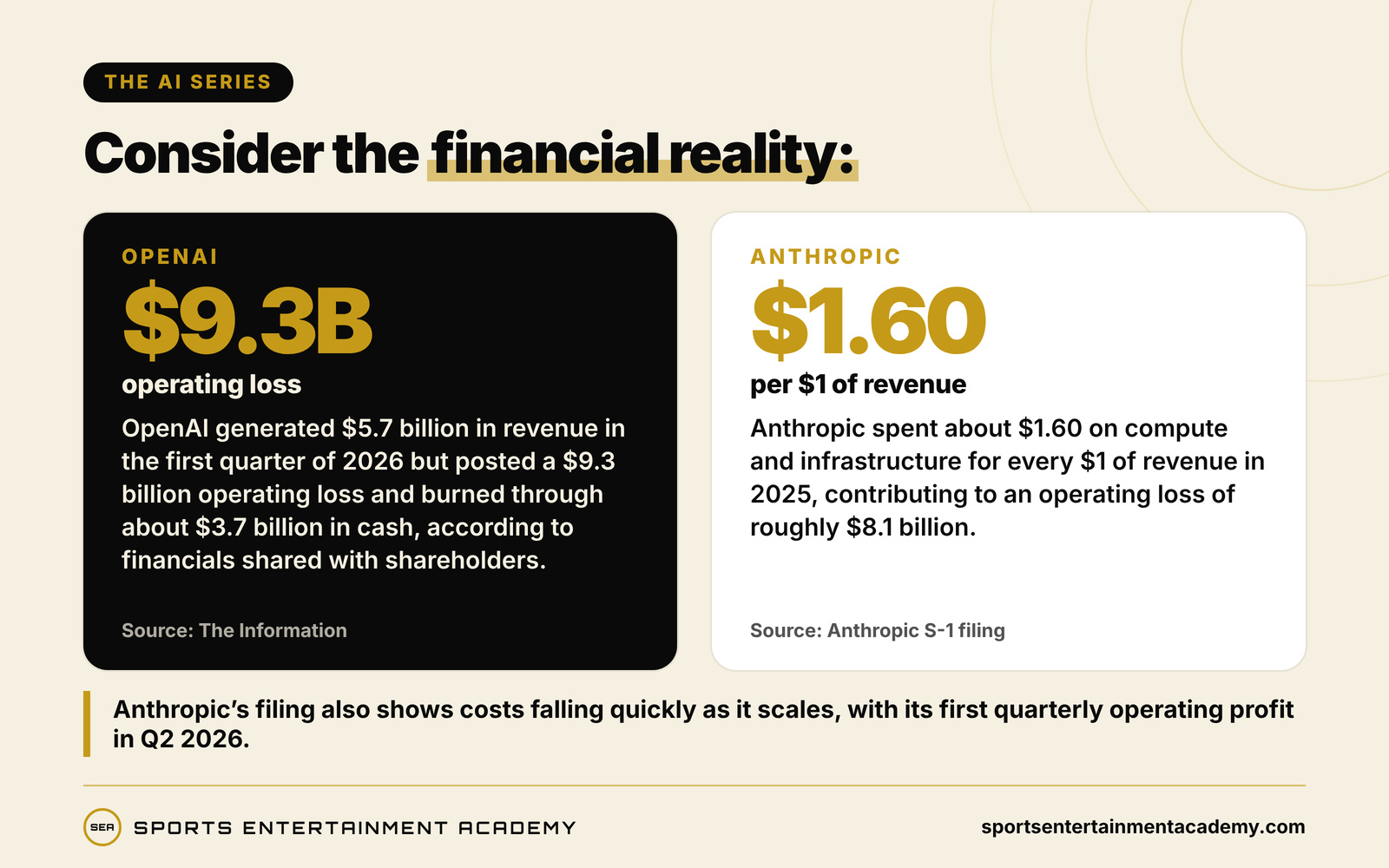
These numbers show the enormous cost of developing and delivering advanced AI. On their own, they don’t prove your subscription is sold below cost. Anthropic’s filing also shows costs falling quickly as it scales, with its first quarterly operating profit in Q2 2026.
But they do raise an important question: Are today’s subscription prices representative of the long-term economics of AI?
We’ve Seen This Business Strategy Before
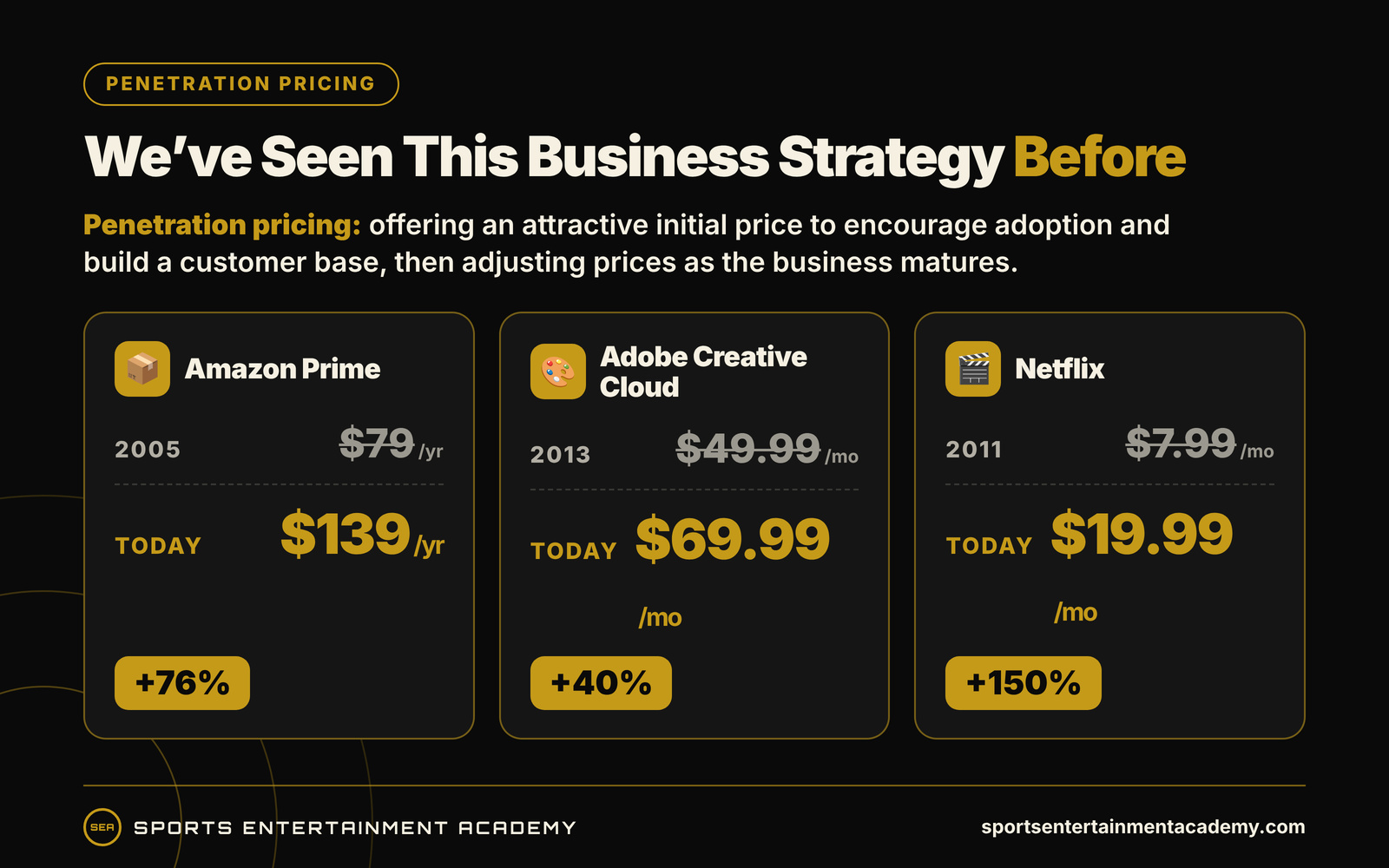
One strategy companies use to gain market share is called penetration pricing: offering an attractive initial price to encourage adoption and build a customer base, then adjusting prices as the business matures.
We’ve seen similar pricing dynamics across several industries:
1. Amazon Prime: E-Commerce & Logistics 📦
Amazon Prime launched in 2005 at $79 per year, offering unlimited two-day shipping on eligible items. Over time, Amazon added benefits such as Prime Video and built an increasingly integrated shopping ecosystem.
As the service evolved, so did its price. Today, a US annual membership costs $139 - a 76% increase from the original launch price.
The lesson? When a subscription becomes part of a customer’s routine, the company can expand its offering and increase revenue per customer.
2. Adobe Creative Cloud: Software & Design 🎨
Adobe transformed the creative software industry in 2013 when it moved from perpetual licenses to its Creative Cloud subscription model. At launch, the full Creative Cloud plan cost $49.99 per month on an annual membership, with an introductory offer of $29.99 per month for eligible existing customers.
Today, Adobe’s Creative Cloud Pro plan costs $69.99 per month for new US subscribers on an annual plan billed monthly. That’s 40% above the original standard price and more than double the introductory offer.
The lesson? Subscription businesses can raise prices as their products evolve and become embedded in professional workflows.
3. Netflix: Entertainment & Streaming 🎬
Netflix helped make subscription streaming a mainstream alternative to video rentals and cable TV. In 2011, its US streaming-only plan cost $7.99 per month. Today, its ad-free Standard plan costs $19.99 per month - a 150% increase.
During that period, Netflix invested heavily in original programming, expanded internationally and built a much larger entertainment library.
The lesson? Price increases reflect more than customer lock-in. Content costs, product changes and the broader economics of the business matter too.
The common thread: A successful subscription becomes increasingly valuable to customers - and increasingly important to a company’s recurring revenue. AI companies are racing to build similarly valuable ecosystems, although their economics won’t necessarily follow the same path as Amazon, Adobe or Netflix.
What Does This Mean for You?
Today’s relatively inexpensive access to increasingly capable AI is a valuable window to learn and experiment.
But don’t assume prices will inevitably skyrocket. Competition, more efficient models and new business models could also keep costs down.
The real opportunity is to build an AI productivity advantage while the tools are accessible.
If you’re spending thousands of tokens repeatedly explaining your goals, preferences and working methods, you’re creating unnecessary friction. The answer isn’t simply to buy a more expensive subscription or use the latest model.
It’s to build a more efficient system.
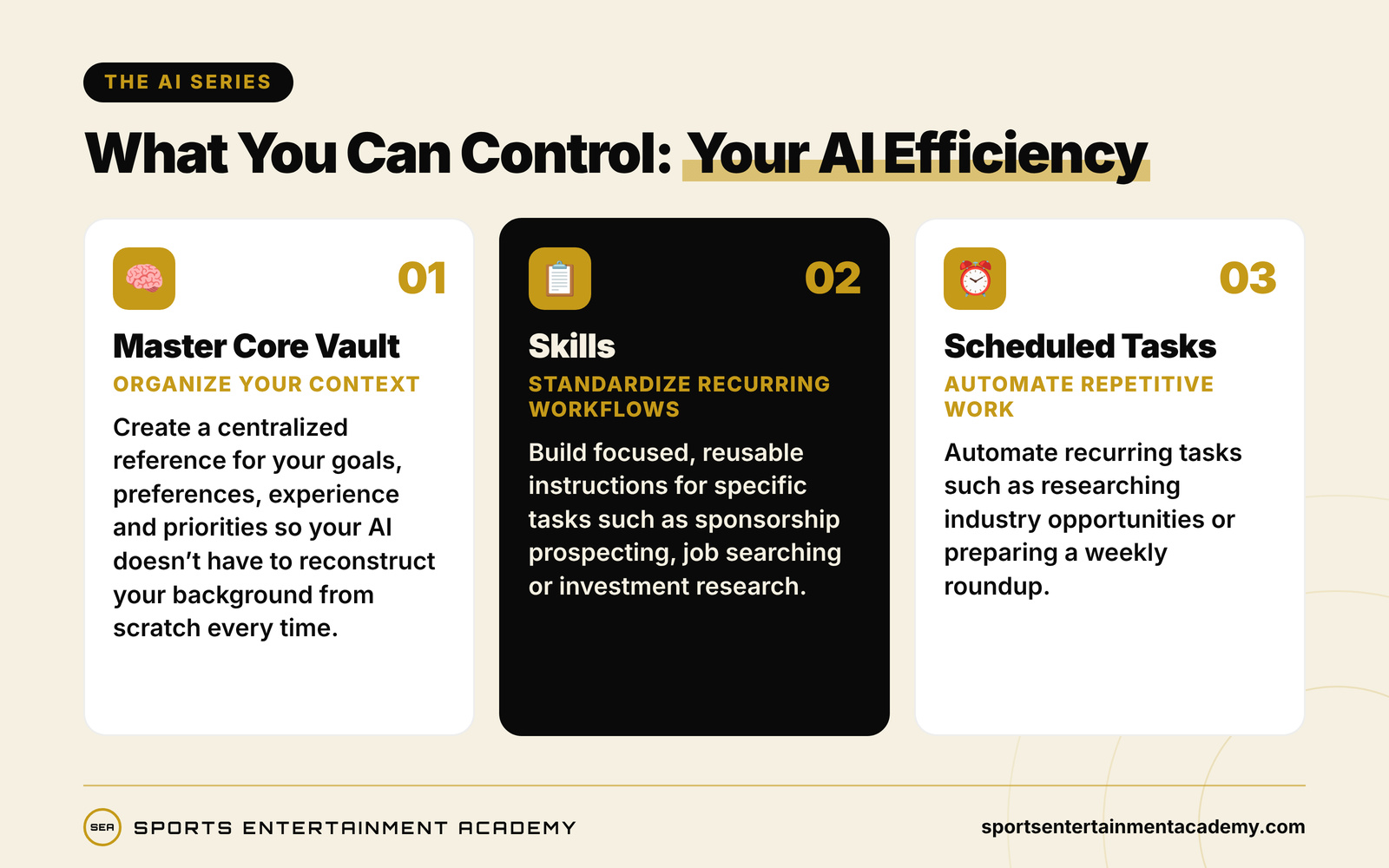
What You Can Control: Your AI Efficiency
In our previous posts in this AI series, we covered three practical ways to structure your AI workflows:
1. Master Core Vault: Organize Your Context
Create a centralized reference for your goals, preferences, experience and priorities so your AI doesn’t have to reconstruct your background from scratch every time.
2. Skills: Standardize Recurring Workflows
Build focused, reusable instructions for specific tasks such as sponsorship prospecting, job searching or investment research. This reduces repetitive prompting and helps your AI apply your criteria consistently.
3. Scheduled Tasks: Automate Repetitive Work
Automate recurring tasks such as researching industry opportunities or preparing a weekly roundup. Spend less time repeating processes and more time reviewing results and making decisions.
If you haven’t read those posts yet, start there.
And if you’re ready to build a more structured AI workflow, apply for our Sports Entertainment Accelerator. We break down the templates, privacy frameworks and workflows you can use to organize your context, create reusable Skills and get more value from your AI tools.
P.S. One More Pro Tip💡
Ask your AI to flag when your Master Core Vault or Skills approach your preferred length limits. For example:
“Alert me when my Master Core Vault reaches 90% of 200 lines or any Skill reaches 90% of 500 lines so we can remove redundancy, simplify instructions and keep the system manageable.”
The goal isn’t to give your AI as much information as possible.
It’s to give it the RIGHT information, in the RIGHT structure, at the RIGHT time 🚀
Author